
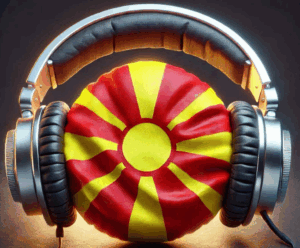
I have just returned from my beloved country, Macedonia, with mixed feelings.
The heat was high – and not only from the summer sun. With local elections ahead, Macedonia seems set for a hot autumn as well. Among the political debates, one in particular caught my attention: the exchange between the mayor of Kavadarci, Jancev, and the musician Spasen. Many now compare Spasen to Croatia’s Thompson – a figure who blends music, patriotism, and politics into a powerful, but divisive, cultural message.
This sparked a deeper question: Do we, as Macedonians, truly value our music? Or do we only use it as a symbol when it serves politics and identity?
The contradiction becomes more striking when our “cousins” from Pirin Macedonia (in Bulgaria) proudly sing our folk songs. Rather than celebrating shared heritage, we often accuse them of “stealing” or “appropriating” what, in reality, we ourselves neglect. At home, many still prefer Serbian, Greek, or Western hits over Macedonian artists. Abroad, even with dedicated groups such as the Macedonian Cultural Artistic Society SONCE in London, the struggle continues: how to keep Macedonian music alive when our own people sometimes undervalue it.
Yet, music is not only art—it is economy, cultural diplomacy, and branding. Nations like Ireland with Celtic music, Jamaica with reggae, or South Korea with K-pop have shown how cultural identity can transform into global economic influence. Music builds soft power, attracts tourism, stimulates creative industries, and forges emotional connections across borders.
Festivals are one of the strongest bridges between culture and economy. Look at Guča in Serbia, where the trumpet festival transforms a small town into a global attraction. Or the Reading and Glastonbury festivals in the UK, where music fuels not only cultural prestige but also billions in tourism revenues. And every summer, somewhere in the world—from Glastonbury to Toronto—you’ll see a proud Macedonian waving our red-and-yellow flag in the crowd. That silent gesture shows the untapped potential: Macedonian music could stand proudly on those stages, not just in the audience.
And let us not forget: Macedonia already has world-class ambassadors. Simon Trpčeski, one of the finest pianists of his generation, performs on the most prestigious stages across continents. Boris Trajanov, our celebrated opera baritone, has long been a cultural bridge between Macedonia and the world. The late Toše Proeski—loved not only at home but across the Balkans—remains a symbol of what Macedonian talent can mean globally. And even today, in London’s prestigious Park Lane hotels, my dear friend Igor Gudzalov proudly entertains international audiences, carrying the Macedonian sound into one of the world’s great cultural capitals. These individuals prove the point: Macedonian music has the quality, the passion, and the talent to stand on the global stage.
But here lies one of our greatest weaknesses: Macedonian artists are rarely present on global platforms like Spotify, Apple Music, or YouTube Music. In today’s digital world, if your music is not online, it simply does not exist to the global audience. A young listener in New York, Tokyo, or São Paulo is more likely to discover Macedonian food through TikTok than a Macedonian song through Spotify. This absence is not just a cultural gap—it is an economic loss. Streaming platforms are the modern stage, and Macedonia’s voice is barely heard on it.
And let us finish where this debate began. Not only in Kavadarci, but in Berovo, Kamenica, and towns across Macedonia, the main singers at festivals and public events often come from our northern neighbour. This is the same as celebrating a Macedonian cabbage festival with imported cabbage from Turkey. It is not just ironic—it is a failure to understand culture as economy, as diplomacy, and as brand.
Macedonia has extraordinary musical talent and a tradition unlike any other. Our rhythms and voices should not be sidelined in our own land. If we do not invest in our music, give our artists a stage, and make them visible to the world, then others will fill the space—and we will be left applauding someone else’s culture at our own festivals.
The time has come to treat our music not as background noise, but as a voice that can project Macedonia to the world.